

Shuffleboard Rules
Table Shuffleboard Rules Helpful Tips How to Play Shuffleboard
Download PDF version of Rules Here
Shuffleboard Game Rules - Information on how to play shuffleboard, including rules and instructions on how to keep score in the most common shuffleboard games.
Video: How to Play Shuffleboard: Shuffleboard Scoring in a Game of Knock Off
Common Shuffleboard Game Rules
Have you ever wondered how to play shuffleboard? Here are the most common shuffleboard rules that generally apply to most games. The rules usually require that you alternately take turns sliding, by hand, all 4 of your weights against the ones from your opponent. Try to make it to the highest scoring area on the shuffleboard without falling off the end of the board into the alley. To earn points, your weights need to be at the bottom of the board. Some of the strategy and fun really come into play when you knock off your opponents' weights, outdistance them, or use your weights to protect your other highest scoring weights.
Usually, the most common games are played either to 15 or 21 points. The sections below cover the shuffleboard game rules for the most famous (and fun) shuffleboard games. We hope you find these game rules helpful forthe enjoyment of your McClure Shuffleboard table.
Table Shuffleboard Game Rules Scoring:
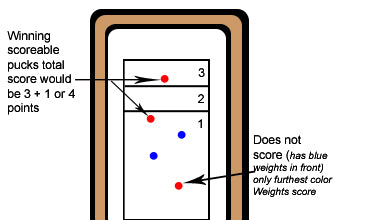
EXAMPLE: If a Red Weight is the most distant Weight from the playing end after a round, Red becomes the winner of the round, and only Red can score. To determine Red’s score, total the value of each Red Weight that lies ahead of the leading Blue Weight. Red Weights, which are either blocked or which lie behind the leading Blue Weight, are not scored. If no Blue Weights are remaining on the board, all remaining Red Weights are scored.
Knock Off Shuffleboard Rules:
Knock Off shuffleboard is one of the simplest and most common ways to play the game. However, just because the rules are simple to remember does not mean the game is easy to play. Any game of shuffleboard can be improved with patience and strategy, and this one is no different. Learn more about the Knock Off Game Rules.
Horse Collar Table Shuffleboard Rules:
Need a high-scoring affair? Horse Collar shuffleboard is played one-on-one or with teams, and the winner must score 51 points. With a fun betting element for those who can’t score and huge shots worth 26 points, Horse Collar is a game that everyone will want to play. Learn more about the Horse Collar Game Rules.
Tap & Draw Shuffleboard Rules:
Unlike Knock Off participants, Tap & Draw players who get to shuffle the first puck have the best advantage. Tap & Draw is played and scored similarly to other versions of the game, but there is one major difference. In Tap & Draw, you can attempt to send your own puck farther up the board by tapping it with another one of your pucks. Learn more about the Tap & Draw Game Rules.
How To Play Shuffleboard Crazy Eight Rules:
As for physically throwing the pucks and keeping score, Crazy Eight offers a version of shuffleboard that is pretty similar to many classic games people play. However, Crazy Eight is a fun and challenging version of shuffleboard because points are scored differently. Learn more about the Crazy Eight Game Rules.
Target Table Shuffleboard Rules:
Just like darts, archery, and riflery, this table shuffleboard game gives you the chance to aim and shoot at a target. With hopes of scoring one, two, three, or four points, use your skills to shoot for a target and bring home the winning game. Only the winner scores in each round, so choose your play wisely. Learn more about Target Game Rules.
If you’ve enjoyed learning the rules and strategies of shuffleboard, you may also be considering what it would be like to have a table of your own. The experience of playing on a precision-built home table is dramatically different from what most people first encounter in a bar or club setting.
Shuffleboard Rules are subject to the tournament director's discretion for the various games of shuffleboard.

